Aftermath News

Entries categorized as ‘One World Religion’

American Stonehenge: Monumental Instructions for the Post-Apocalypse

April 22, 2009 · 6 Comments

georgia_guidestones

The Georgia Guidestones may be the most enigmatic monument in the US: huge slabs of granite, inscribed with directions for rebuilding civilization after the apocalypse. Only one man knows who created them—and he’s not talking. Photo: Dan Winters

Wired | Apr 20, 2009

By Randall Sullivan

The strangest monument in America looms over a barren knoll in northeastern Georgia. Five massive slabs of polished granite rise out of the earth in a star pattern. The rocks are each 16 feet tall, with four of them weighing more than 20 tons apiece. Together they support a 25,000-pound capstone. Approaching the edifice, it’s hard not to think immediately of England’s Stonehenge or possibly the ominous monolith from 2001: A Space Odyssey. Built in 1980, these pale gray rocks are quietly awaiting the end of the world as we know it.

Called the Georgia Guidestones, the monument is a mystery—nobody knows exactly who commissioned it or why. The only clues to its origin are on a nearby plaque on the ground—which gives the dimensions and explains a series of intricate notches and holes that correspond to the movements of the sun and stars—and the “guides” themselves, directives carved into the rocks. These instructions appear in eight languages ranging from English to Swahili and reflect a peculiar New Age ideology. Some are vaguely eugenic (guide reproduction wisely—improving fitness and diversity); others prescribe standard-issue hippie mysticism (prize truth—beauty—love—seeking harmony with the infinite).

What’s most widely agreed upon—based on the evidence available—is that the Guidestones are meant to instruct the dazed survivors of some impending apocalypse as they attempt to reconstitute civilization. Not everyone is comfortable with this notion. A few days before I visited, the stones had been splattered with polyurethane and spray-painted with graffiti, including slogans like “Death to the new world order.” This defacement was the first serious act of vandalism in the Guidestones’ history, but it was hardly the first objection to their existence. In fact, for more than three decades this uncanny structure in the heart of the Bible Belt has been generating responses that range from enchantment to horror. Supporters (notable among them Yoko Ono) have praised the messages as a stirring call to rational thinking, akin to Thomas Paine’s The Age of Reason. Opponents have attacked them as the Ten Commandments of the Antichrist.

Whoever the anonymous architects of the Guidestones were, they knew what they were doing: The monument is a highly engineered structure that flawlessly tracks the sun. It also manages to engender endless fascination, thanks to a carefully orchestrated aura of mystery. And the stones have attracted plenty of devotees to defend against folks who would like them destroyed. Clearly, whoever had the monument placed here understood one thing very well: People prize what they don’t understand at least as much as what they do.

The story of the Georgia Guidestones began on a Friday afternoon in June 1979, when an elegant gray-haired gentleman showed up in Elbert County, made his way to the offices of Elberton Granite Finishing, and introduced himself as Robert C. Christian. He claimed to represent “a small group of loyal Americans” who had been planning the installation of an unusually large and complex stone monument. Christian had come to Elberton—the county seat and the granite capital of the world—because he believed its quarries produced the finest stone on the planet.

Joe Fendley, Elberton Granite’s president, nodded absently, distracted by the rush to complete his weekly payroll. But when Christian began to describe the monument he had in mind, Fendley stopped what he was doing. Not only was the man asking for stones larger than any that had been quarried in the county, he also wanted them cut, finished, and assembled into some kind of enormous astronomical instrument.

What in the world would it be for? Fendley asked. Christian explained that the structure he had in mind would serve as a compass, calendar, and clock. It would also need to be engraved with a set of guides written in eight of the world’s major languages. And it had to be capable of withstanding the most catastrophic events, so that the shattered remnants of humanity would be able to use those guides to reestablish a better civilization than the one that was about to destroy itself.

Full Story

Categories: Artificial Scarcity · Bizarre · Death Culture · Depopulation · Global Government · Illuminati · Occult Agenda · One World Religion · Order Out Of Chaos · Propaganda · Secret Societies · Social Engineering

Prince of Wales calls for ‘bridges’ to be built between faiths

February 27, 2009 · 2 Comments

charles_lord_vampire

Prince Charles has spoken of the need for society to develop understanding and find strength in diversity to help overcome ‘dangerous prejudice’

The Prince of Wales called for bridges to be built between faiths as he addressed members of a centre for Islamic studies at a special dinner.

Telegraph | Feb 26, 2009

He talked of the need for society to develop understanding and find strength in diversity to help overcome “dangerous prejudice”.

The Prince was speaking at a reception hosted by The Oxford Centre for Islamic Studies, a recognised independent Centre of Oxford University.

Established in 1985 the Centre encourages a better understanding of the culture and civilisation of Islam and of contemporary Muslim societies.

The Centre, of which the Prince is patron, pursues academic excellence through teaching, research and publication, and the cultivation of sustained dialogue and collaboration within the global academic community.

The Prince, who was invited in celebration of his 60th birthday, last night addressed an audience including local dignitaries, scholars and other guests including Jack Straw at the university’s Magdalen College.

He told them: “One of the challenges we face is the process of integration which in many ways is a dynamic one, evolved with each successive generation.

“To be successful in developing a truly harmonious society in which everyone’s talent can be recognised and developed on its own merits, we have to find the right ways to derive strength from our diversity.

“As inhabitants of this country we all have a role to play in shaping our society on the basis of one fundamental principle and that is understanding.”

The Prince said the great faiths needed to concentrate on what they shared in common rather than “an obsession with the differences between them” and the chasms that creates.

He added: “The future surely lies in rediscovering the universal truths that dwell at the heart of these religions.

“All I have ever wanted to do is build bridges that span these chasms.”

The Prince said he was delighted by the Centre’s work in increasing understanding and breaking down barriers.

He also talked about the Centre’s positive response to raising awareness of the need to protect the environment and “human stewardship” of the natural world.

He thanked the Centre for helping conduct research into conservation practices in the Islamic world including methods of preserving rainwater.

At present Centre Fellows teach in a range of departments and faculties of the University of Oxford including Politics, International Relations, Development Studies, Theology, Anthropology, History and Continuing Education.

It attracts visiting scholars from all parts of the Muslim world.

It is currently constructing a new building including a library, auditorium, prayer hall, dining hall and exhibition gallery.

Next year it will begin a scholarship programme for young British Muslims.

Dr Farhan Nizami, the Director of the Centre, paid tribute to the Prince’s “guidance and encouragement” and said they owed him a great debt of gratitude.

He said: “These great environmental practices are examples of how the centre is trying to learn from the works of his Royal Highness.

“We wish to contribute to a society where people work together for the common good and equality and mutual respect.”

Categories: Feudalism & Neofeudalism · One World Religion · Religion

Obama stresses unity among religions, prepares faith office

February 7, 2009 · 3 Comments

Egan_admiring_obama

Obama with Cardinal Egan. The White House Office of Faith-Based Partnerships has drawn criticism for blurring the line separating church and state

Earth Times | Feb 5, 2009

Washington – US President Barack Obama on Thursday reached out to believers of all faiths as he expanded the White House office of faith-based partnerships. Speaking at the National Prayer Breakfast in Washington, Obama acknowledged differences among religions, but stressed the common beliefs of all faiths to care for others.

“Instead of driving us apart, our varied beliefs can bring us together to feed the hungry and comfort the afflicted; to make peace where there is strife and rebuild what has broken; to lift up those who have fallen on hard times,” he said.

“This is not only our call as people of faith, but our duty as citizens of America, and it will be the purpose of the White House Office of Faith-Based and Neighbourhood Partnerships that I’m announcing later today.”

Former president George W Bush created a White House Office of Faith-Based Initiatives that helped religious groups seek grants to provide social services. Obama, who signed an order later Thursday creating his own programme, is expected to keep a similar structure. He has also created a council of religious advisors from various backgrounds to provide input on policy.

The office has drawn criticism for blurring the line separating church and state, but Obama insisted his work would not favour religious groups over secular ones but simply allow all organizations to provide services to their communities.

Obama made an effort during his election campaign to reach out to religious groups, even designating staff specifically to the task. He faced controversies, however, over inflammatory statements made by his then-pastor and rumours that he was a Muslim.

At the breakfast, Obama outlined his religious journey as the child of a Muslim father who became an atheist and non-religious mother, and how he became a Christian as an adult while working with disadvantaged residents in Chicago.

The breakfast draws thousands, including many legislators and religious leaders, each year. Former British prime minister Tony Blair gave the key note address, speaking of religion’s attack from extremists within and non-believers.

Haitian President Rene Preval, Philippine President Gloria Macapagal-Arroyo, Albanian Prime Minister Sali Berisha, Macedonian Prime Minister Nikola Gruevski and Mauritius Prime Minister Navinchandra Ramgoolam also attended.

Categories: Economic Meltdown · One World Religion · Religion · Theocracy

Blair hails ‘God’s love’ in extraordinary speech as he stands alongside Obama at prayer breakfast

February 6, 2009 · 6 Comments

Obama

‘My good friend’: Barack Obama applauds Blair’s speech to the Prayer Breakfast in Washington

Daily Mail | Feb 6, 2009

By Michael Lea

Tony Blair famously ‘didn’t do God’ during his decade in Downing Street, fearing he would be viewed as a religious fanatic.

But the former Prime Minister lectured the world yesterday on the need to put faith at the heart of global affairs.

In an impassioned ’sermon’ in the U.S. he made no fewer than 31 mentions of God, and declared: ‘In surrendering to God we become instruments of his love’.

Mr Blair also scored a diplomatic coup as the first ‘world leader’ to shake hands with President Barack Obama, who hailed him as ‘my good friend’.

He said Mr Blair ‘did it first and perhaps did it better’ and had been an example to so many people around the world ‘of what dedicated leadership can accomplish’.

The exchanges will cause frustration in Number 10, where Gordon Brown is still awaiting an invitation to Washington.

The former Premier was speaking in the U.S. capital at the annual National Prayer Breakfast.

In a sharp departure from his days in power – his spin doctor Alastair Campbell once told reporters ‘We don’t do God’ – he spoke passionately of his faith.

Although traditionalists will welcome the remarkably frank and passionate speech, others will also point out that for 10 years Mr Blair led a Government addicted to the casual lying that comes with political spin and took the country into a disastrous war on the flimsiest of evidence.

Mr Blair, who converted to Roman Catholicism after leaving Downing Street, gave a revealing insight into how he felt unable to discuss religion there.

He said: ‘I recall giving an address to the country at a time of crisis. I wanted to end my words with “God bless the British people”.

‘This caused complete consternation. Emergency meetings were convened. The system was aghast. Finally, a senior civil servant said, with utter disdain: “Really, Prime Minister, this is not America you know”.’

Yesterday he threw off those inhibitions and said: ‘I believe restoring religious faith to its rightful place, as the guide to our world and its future, is itself of the essence.

‘The 21st century will be poorer in spirit, meaner in ambition, less disciplined in conscience, if it is not under the guardianship of faith in God.’

Mr Blair, now the international peace envoy to the Middle East, said his new job meant he spent a great deal of time in the Holy Land.

He said: ‘It is a good place to reflect on religion – a source of so much inspiration, an excuse for so much evil. Today, religion is under attackfrom without and from within. From within, it is corroded by extremists who use their faith as a means of excluding the other.

‘From without, religious faith is assailed by an increasingly aggressive secularism, which derides faith as contrary to reason and defines faith by conflict.

‘Thus the extreme believers and the aggressive non-believers come together in unholy alliance.’

Mr Blair recalled an incident when he was just ten and his father Leo suffered a stroke. A teacher wanted to pray for him, but Mr Blair confessed that his father did not believe in God. The teacher reassured him: ‘That doesn’t matter, God believes in him.’

The former Premier said: ‘That is what inspires – the unconditional nature of God’s love’. Leo Blair, now 85, survived the stroke.

A humorous Mr Blair charmed his audience with self deprecation but also by displaying his passionate Christianity.

He told Mr Obama: ‘As you begin your leadership of this great country, Mr President, you are fortunate, as is your nation, that you have already shown in your life, courage in abundance.

‘But should it ever be tested, I hope your faith can sustain you and your family.’

By return, the President praised ‘my good friend Tony Blair – who did it first and perhaps did it better’ at the head of a list of personal acknowledgments.

Mr Blair ended his speech: ‘By the way, God bless you all.’

Categories: Bizarre · Christianity · Crime & Corruption · Obama · One World Religion · Religion · Theocracy

Anglican-Catholic Reunion in the Works

February 4, 2009 · Leave a Comment

pope_anglicans

Pope Benedict XVI welcomes dissatisfied Anglicans back into the mother church. (Getty Images)

The Trumpet | Feb 4, 2009

The pope is preparing to accept half a million disgruntled Anglicans into the Roman Catholic Church. Australian Catholic weekly The Record reports that the Vatican will accord the Traditional Anglican Communion a personal prelature if unity talks succeed.

“History may be in the making,” begins the Record article. “It appears Rome is on the brink of welcoming close to half a million members of the Traditional Anglican Communion into membership of the Roman Catholic Church. Such a move would be the most historic development in Anglican-Catholic relations in the last 500 years. But it may also be a prelude to a much greater influx of Anglicans waiting on the sidelines, pushed too far by the controversy surrounding the consecration of practicing homosexual bishops, women clergy and a host of other issues.”

The Traditional Anglican Communion is a group of churches with a worldwide membership of 400,000 people. It formed in 1990 from a dozen Anglican churches that broke away from the 80-million-strong Anglican Communion (of which the Church of England is the heart), mostly to protest the liberalism creeping into that organization.

In October 2007, the Traditional Anglican Communion sent a letter formally requesting “full, corporate and sacramental union” with the Roman Catholic Church, which has since been under review by the Vatican.

The Vatican’s Congregation for the Doctrine of the Faith has decided to recommend that the Traditional Anglican Communion be offered a person prelature. This would put the communion in the same position as Opus Dei. The Record explains that a personal prelature is “something like a global diocese without boundaries, headed by its own bishop and with its own membership and clergy.”

The Trumpet has followed this subject closely because of its prophetic significance. For half a century, Herbert W. Armstrong and his Plain Truth magazine expounded on biblical prophecies foretelling the unification of Protestants with their Roman Catholic mother church. The October 1961 Plain Truth, for example, said this: “The pope will step in as the supreme unifying authority—the only one that can finally unite the differing nations of Europe. … Europe will go Roman Catholic! Protestantism will be absorbed into the ‘mother’ church—and totally abolished.”

This prophecy is in process of being fulfilled right now. The Vatican is expected to possibly announce its decision to absorb the Traditional Anglican Communion around April this year.

The eagerness of the Vatican to absorb the Anglican communion, and the lengths to which the communion is prepared to go to be accepted by Rome—“no matter what the personal cost”—is an indication of things to come.

Read Trumpet editor in chief Gerald Flurry’s article “Anglicans Submitting to the Pope” and “Returning to the Fold,” by Stephen Flurry, to learn how full unity between the Anglicans and Catholics will finally be achieved. •

Categories: Christianity · One World Religion · Religion · Vatican

Dissident Anglicans poised to join Catholics

January 30, 2009 · 1 Comment

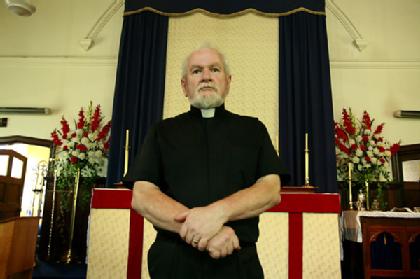
graeme-mitchell

Disaffected Anglican priest Graeme Mitchell hopes and prays he will become a full member of the Catholic Church. Photo: Michael Clayton-Jones

Reunion would be the most important advance in Catholic/Anglican relations since 1553, when “Bloody” Queen Mary briefly returned England to Catholicism.

WA Today | Jan 29, 2009

By Barney Zwartz

NEARLY half a million dissident Anglicans are on the verge of rejoining the Catholic Church in a move their leader suggests may be the beginning of a flood to Rome of millions of Anglicans worldwide who oppose gay and female clergy.

Vatican officials are believed to have recommended to Pope Benedict XVI that he accept the Traditional Anglican Communion under a special category, and an announcement is expected in April.

Related

West Australian Catholic newspaper The Record yesterday reported the Congregation for the Doctrine of the Faith has decided to recommend to the Pope that he create a “personal prelature” for the TAC, which leading Anglicans confirmed.

Reunion would be the most important advance in Catholic/Anglican relations since 1553, when “Bloody” Queen Mary briefly returned England to Catholicism. The mainstream Anglican Church is also holding discussions with the Vatican, but they are not close to union.

If the Pope agrees, the TAC, which has a large number of married bishops and priests, would answer to the Pope but keep their existing structure, clergy and some elements of Anglican identity. At present, the Catholic Church has only one personal prelature, the ultra-conservative Opus Dei.

The TAC’s primate (global leader), Adelaide-based Archbishop John Hepworth, said yesterday: “We are quietly and optimistically waiting for an answer. All 60 bishops accept the role of the Pope, the Catholic catechism and the traditional claims of the church, and want to be part of it.”

The TAC has more than 400,000 members in 41 countries, and is not in relationship with the mainstream Anglican Church. In Australia, it has about 1600 members.

Archbishop Hepworth said if the Pope approved, the TAC would be a beacon for Anglicans around the world dreaming of doctrinal stability and unity.

Representative of the disaffected Anglicans is Father Graeme Mitchell, who is hoping to join his fourth church, but says this time “I feel like I’m coming home”.

Married with two children, Father Graeme began life as a Presbyterian, followed his mother to the Anglican Church, and in 1987 was one of the founders of the breakaway Anglo-Catholic Church of Australia.

This year, Father Graeme — parish priest at St Mary the Virgin in Caulfield South and registrar of the TAC diocese of Australia — hopes and prays he will join the half-million other former Anglicans as a full member of the Catholic Church.

His disillusionment with the Anglican Church began mounting in 1987, when the Melbourne synod made the Catholic sacrament of confirmation optional. “It seemed to me a betrayal of what I’d been brought up to in the Catholic faith,” he says.

Categories: Christianity · One World Religion · Secret Societies · Vatican

Blair, his ’sexy’ Catholic aide, and their new Yale HQ near her Opus Dei father’s office

January 5, 2009 · Leave a Comment

blair_turner_opus-dei

Still close: Tony Blair and Ruth Turner, his controversial former Downing Street aide, at Yale last month. Turner accompanied Blair to Yale for his seminars on faith and globalization in support of his new religious charity

Professor Turner is a prominent writer and scholar who once described himself as a ‘Marxist Catholic’. And intriguingly he is a former member of Opus Dei, a conservative Catholic lay organisation shrouded in mystery with rituals that include wearing a cilice – a spiked chain strapped around the thigh.

Daily Mail | Jan 4, 2009

By SHARON CHURCHER in New York and SIMON WALTERS in London

Tony Blair is setting up an American office for his religious charity in a move that sheds new light on his close links with Ruth Turner, his controversial former Downing Street aide.

Ms Turner, 38, who was at the heart of the cash-for-honours inquiry in 2006 and 2007, was chosen by the former Prime Minister last spring to run his new Tony Blair Faith Foundation.

It has become a highly lucrative vehicle for the ex-premier, concentrating its activities at America’s Yale University, where Mr Blair teaches a course on ‘faith and globalisation’ – and where Ms Turner’s British-born father, Denys, is a theology professor.

Yale, which is one of America’s top three universities, has paid the foundation more than £127,000 since it appointed Mr Blair as its Howland Distinguished Fellow.

A recent posting on the foundation’s website announced that ‘a small team of staff’ will be based on the campus to ‘extend the [foundation’s] reach across North America’.

Yale maintains that Mr Blair’s post has nothing to do with Ms Turner’s father. But yesterday the university confirmed that the foundation’s office will be in the picturesque neo-Georgian divinity school complex, where Ms Turner’s father is based.

The foundation insists it wants to promote understanding between world religions. But The Mail on Sunday has been told that several of its key figures are Catholics.

Mr Blair converted to Catholicism in 2007 with his wife Cherie, a Catholic, as his sponsor. It is less well known that it is a faith he shares with Ms Turner and her father. Sources close to the Blairs say that Ms Turner was one of the figures in whom Mr Blair confided as he decided whether to convert to Catholicism.

Professor Turner is a prominent writer and scholar who once described himself as a ‘Marxist Catholic’. And intriguingly he is a former member of Opus Dei, a conservative Catholic lay organisation shrouded in mystery with rituals that include wearing a cilice – a spiked chain strapped around the thigh.

Author Dan Brown is accused of exaggerating its alleged secretive sadomasochistic practices in his best-selling novel The Da Vinci Code. According to Catholic magazine The Tablet, Professor Turner was a member of Opus Dei for eight years and faced threats that he would ‘lose his soul’ when he left.

The magazine said that Professor Turner believed Opus Dei ‘traded on the instinct which Catholics had for obedience, exercised a kind of mind control and cultivated a psychology of dependence’.

The article continued: ‘He des-cribes leaving as a catastrophic experience for him and was told he would lose his soul over it.’

Ms Turner accompanied Mr Blair to Yale last month for his seminars on faith and globalisation. And breaking her silence about her association with him for the first time, she contributed to an article about him in New York magazine.

Speaking warmly about Mr Blair’s devotion to the new charity, she declared: ‘You can make the case extremely convincingly for why religion is an absolutely terrible thing, and you’ll be right in every respect. Except for the fact that it’s not only like that and, anyway, it’s not going to go away.’

She disclosed that she is so close to him she can predict his choice of clothing when he visits his old haunts in the North-East of England. ‘Whenever he goes back, it’s fantastic,’ she said gushingly. ‘He wears a tracksuit all day.’

Ms Turner was born in Dublin in 1970 and spent her childhood moving between university towns as her father’s career took off. He was a professor of theology at Cambridge before his appointment at Yale.

She is a committed socialist and launched the Northern version of Big Issue magazine, where she earned a formidable reputation for using her charm to raise big sums of money from businesses. It was when she joined Labour’s ruling National Executive Committee in 2000 that she caught the eye of Mr Blair, who promptly recruited her to No 10. A former Downing St aide said: ‘Ruth is clever, sexy and has a sparkling personality. Everybody loved her at No 10. Underneath it all, she is very tough, but she has this delicate vulnerable look that makes you want to put your arm round her.’

Ms Turner worked 18-hour days at Downing Street, often reporting directly to Mr Blair.

He displayed fierce loyalty to her when she was arrested and quizzed by police in the cash-for-honours row, and took the unusual step of issuing a statement defending her. ‘Ruth is a person of the highest integrity for whom I have great regard and I continue to have complete confidence in her,’ he said.

After being cleared in the scandal, Ms Turner remained loyal to Mr Blair. When he left No 10 in 2007, she was top of the list of Downing Street staff he wanted to take with him.

Professor Turner told The Mail on Sunday that he had gone to great lengths to avoid any connection to Mr Blair’s activities at Yale. ‘I have been careful to be sure that my relationship with Ruth is kept entirely out of the way of her professional relationship with Tony Blair,’ he said.

Explaining why he left Opus Dei, Professor Turner said: ‘I moved in a pendulum-like way into a rather opposed position politically and eventually the pendulum settled down in the middle somewhere.

‘I am a Catholic, but I wouldn’t describe myself as a Marxist now. I’ve been through that phase and came out of it at the other end.’

A spokesman for Mr Blair said yesterday: ‘Professor Turner is a highly respected member of the [Yale] faculty but he had no role in establishing the partnership between Yale and the foundation.’

Asked about the foundation’s expansion plans and whether Catholicism played a role in it, his spokesman drew attention to an article on its website, which said: ‘As Prime Minister of Britain, Tony Blair was officially an Anglican. Unofficially, though, he was a practising Roman Catholic.’

It goes on to quote Mr Blair as saying: ‘My wife’s Catholic, my kids are brought up as Catholics, I’ve been going to mass for 25 years,’ and it comments: ‘In a way, Blair’s foundation is the culmination of his life as a double agent.’

Categories: Bizarre · Christianity · Crime & Corruption · Cults · Global Government · Globalization · Illuminati · One World Religion · Secret Societies · Social Engineering · Socialism · Theocracy · Vatican

Words associated with Christianity and British history taken out of children’s dictionary

December 7, 2008 · 5 Comments

Words associated with Christianity, the monarchy and British history have been dropped from a leading dictionary for children.

Telegraph | Dec 6, 2008

By Julie Henry

Oxford University Press has removed words like “aisle”, “bishop”, “chapel”, “empire” and “monarch” from its Junior Dictionary and replaced them with words like “blog”, “broadband” and “celebrity”. Dozens of words related to the countryside have also been culled.

The publisher claims the changes have been made to reflect the fact that Britain is a modern, multicultural, multifaith society.

But academics and head teachers said that the changes to the 10,000 word Junior Dictionary could mean that children lose touch with Britain’s heritage.

“We have a certain Christian narrative which has given meaning to us over the last 2,000 years. To say it is all relative and replaceable is questionable,” said Professor Alan Smithers, the director of the centre for education and employment at Buckingham University. “The word selections are a very interesting reflection of the way childhood is going, moving away from our spiritual background and the natural world and towards the world that information technology creates for us.”

An analysis of the word choices made by the dictionary lexicographers has revealed that entries from “abbey” to “willow” have been axed. Instead, words such as “MP3 player”, “voicemail” and “attachment” have taken their place.

Lisa Saunders, a worried mother who has painstakingly compared entries from the junior dictionaries, aimed at children aged seven or over, dating from 1978, 1995, 2000, 2002, 2003 and 2007, said she was “horrified” by the vast number of words that have been removed, most since 2003.

“The Christian faith still has a strong following,” she said. “To eradicate so many words associated with the Christianity will have a big effect on the numerous primary schools who use it.”

Ms Saunders realised words were being removed when she was helping her son with his homework and discovered that “moss” and “fern”, which were in editions up until 2003, were no longer listed.

“I decide to take a closer look and compare the new version to the other editions,” said the mother of four from Co Down, Northern Ireland. “I was completely horrified by the vast number of words which have been removed. We know that language moves on and we can’t be fuddy-duddy about it but you don’t cull hundreds of important words in order to get in a different set of ICT words.”

Anthony Seldon, the master of Wellington College, a leading private school in Berkshire, said: “I am stunned that words like “saint”, “buttercup”, “heather” and “sycamore” have all gone and I grieve it.

“I think as well as being descriptive, the Oxford Junior Dictionary, has to be prescriptive too, suggesting not just words that are used but words that should be used. It has a duty to keep these words within usage, not merely pander to an audience. We are looking at the loss of words of great beauty. I would rather have “marzipan” and “mistletoe” then “MP3 player.”

Oxford University Press, which produces the junior edition, selects words with the aid of the Children’s Corpus, a list of about 50 million words made up of general language, words from children’s books and terms related to the school curriculum. Lexicographers consider word frequency when making additions and deletions.

Vineeta Gupta, the head of children’s dictionaries at Oxford University Press, said: “We are limited by how big the dictionary can be – little hands must be able to handle it – but we produce 17 children’s dictionaries with different selections and numbers of words.

“When you look back at older versions of dictionaries, there were lots of examples of flowers for instance. That was because many children lived in semi-rural environments and saw the seasons. Nowadays, the environment has changed. We are also much more multicultural. People don’t go to Church as often as before. Our understanding of religion is within multiculturalism, which is why some words such as “Pentecost” or “Whitsun” would have been in 20 years ago but not now.”

She said children’s dictionaries were trailed in schools and advice taken from teachers. Many words are added to reflect the age-related school curriculum.

Words taken out:

Carol, cracker, holly, ivy, mistletoe

Dwarf, elf, goblin

Abbey, aisle, altar, bishop, chapel, christen, disciple, minister, monastery, monk, nun, nunnery, parish, pew, psalm, pulpit, saint, sin, devil, vicar

Coronation, duchess, duke, emperor, empire, monarch, decade

adder, ass, beaver, boar, budgerigar, bullock, cheetah, colt, corgi, cygnet, doe, drake, ferret, gerbil, goldfish, guinea pig, hamster, heron, herring, kingfisher, lark, leopard, lobster, magpie, minnow, mussel, newt, otter, ox, oyster, panther, pelican, piglet, plaice, poodle, porcupine, porpoise, raven, spaniel, starling, stoat, stork, terrapin, thrush, weasel, wren.

Acorn, allotment, almond, apricot, ash, bacon, beech, beetroot, blackberry, blacksmith, bloom, bluebell, bramble, bran, bray, bridle, brook, buttercup, canary, canter, carnation, catkin, cauliflower, chestnut, clover, conker, county, cowslip, crocus, dandelion, diesel, fern, fungus, gooseberry, gorse, hazel, hazelnut, heather, holly, horse chestnut, ivy, lavender, leek, liquorice, manger, marzipan, melon, minnow, mint, nectar, nectarine, oats, pansy, parsnip, pasture, poppy, porridge, poultry, primrose, prune, radish, rhubarb, sheaf, spinach, sycamore, tulip, turnip, vine, violet, walnut, willow

Words put in:

Blog, broadband, MP3 player, voicemail, attachment, database, export, chatroom, bullet point, cut and paste, analogue

Celebrity, tolerant, vandalism, negotiate, interdependent, creep, citizenship, childhood, conflict, common sense, debate, EU, drought, brainy, boisterous, cautionary tale, bilingual, bungee jumping, committee, compulsory, cope, democratic, allergic, biodegradable, emotion, dyslexic, donate, endangered, Euro

Apparatus, food chain, incisor, square number, trapezium, alliteration, colloquial, idiom, curriculum, classify, chronological, block graph

Categories: Child Takeover · Christianity · Global Government · Globalization · Mind Control · Multi-culturalism · One World Religion · Religion · Social Engineering

Bishops call for Muslim prayer rooms in all Catholic schools

December 3, 2008 · 4 Comments

muslim_prayer_room

Muslims pray: Bishops want prayer rooms opened in every Roman Catholic school (file photo)

Muslim prayer rooms should be opened in Catholic schools, say church leaders

Daily Mail | Dec 2, 2008

By Simon Caldwell

Muslim prayer rooms should be opened in every Roman Catholic school, church leaders have said.

The Catholic bishops of England and Wales also want facilities in schools for Islamic pre-prayer washing rituals.

The demands go way beyond legal requirements on catering for religious minorities.

But the bishops – who acknowledge 30 per cent of pupils at their schools hold a non-Christian faith – want to answer critics who say religious schools sow division.

The recommendations were made in a document, Catholic Schools, Children of Other Faiths and Community Cohesion.

‘If practicable, a room (or rooms) might be made available for the use of pupils and staff from other faiths for prayer,’ the bishops said.

‘Existing toilet facilities might be adapted to accommodate individual ritual cleansing which is sometimes part of religious lifestyle and worship.

‘If such space is not available on a permanent or regular basis, extra efforts might be made to address such need for major religious festivals.’

The Islamic cleansing ritual, called ‘Wudhu’, is carried out by Muslims before they pray.

Islam teaches that Muslims are unfit for prayer if they have not performed Wudhu after breaking wind or using the toilet.

Wudhu involves washing the face, hands, arms and feet three times each, gargling the mouth three times and washing the neck and inside the nose and ears. Some Muslims also wash their private parts.

Catholic schools would need to install bidets, foot spas and hoses to facilitate such extensive cleansing rituals, Muslims say.

Daphne McLeod, a former Catholic head teacher from south London, said it would be ‘terribly expensive’ for the country’s 2,300 Catholic primary and secondary schools to provide ritual cleansing facilities.

She said: ‘If Muslim parents choose a Catholic school then they accept that it is going to be a Catholic school and there will not be facilities for ritual cleansing and prayer rooms.

‘They do their ritual cleansing before they go to a mosque, but they are not going to a mosque.

‘I don’t think the bishops should go looking for problems. Where will it stop?’

But Majid Khatme, a Muslim who sent his children to a London Catholic school, said he was delighted by the gesture.

‘It is very kind of the bishops if they give this facility for Muslims to pray,’ he said.

‘I would love to send a letter of thanks to the bishops, really. If they do this all Muslims in Britain will be thankful to the Catholic Church to have facilities to pray. It is very, very encouraging.’

The recommendations have been approved by Vincent Nichols, Archbishop of Birmingham and the favourite to succeed Cardinal Cormac Murphy-O’Connor as Catholic primate.

But it would be up to governing bodies of each school to decide whether to act on the guidance.

Categories: Christianity · Islam · One World Religion · Religion · Social Engineering · Vatican

Vatican thanks Muslims for bringing God back into the public eye in Europe

December 3, 2008 · 1 Comment

cardinal_tauran

Cardinal Jean-Louis Tauran says Muslims have brought debate about religion into the public sphere

Daily Mail | Nov 28, 2008

The Vatican has thanked Muslims for bringing God back into the public sphere in Europe.

Cardinal Jean-Louis Tauran, head of the Catholic Church’s department for interfaith contacts, said religion was now talked and written about more than ever before in today’s Europe.

‘It’s thanks to the Muslims,’ he said in a speech printed in Friday’s L’Osservatore Romano, the official daily of the Vatican.

‘Muslims, having become a significant minority in Europe, were the ones who demanded space for God in society.’

Vatican officials have long bemoaned the secularisation of Europe, where church attendance has dwindled dramatically in recent decades, and urged a return to its historically Christian roots.

But Tauran said no society had only one faith.

‘We live in multicultural and multi-religious societies, that’s obvious,’ he told a meeting of Catholic theologians in Naples.

‘There is no civilisation that is religiously pure.’

Tauran’s positive speech on interfaith dialogue came after a remark by Pope Benedict prompted media speculation that the Vatican was losing interest in it.

Some Jewish leaders reacted with expressions of concern and the Vatican denied any change.

The ‘return of God’ is clearly seen in Tauran’s native France, where Europe’s largest Muslim minority has brought faith questions such as women’s headscarves into the political debate after decades when they were considered strictly private issues.

Tauran said religions were ‘condemned to dialogue,’ a practice he called ‘the search for understanding between two subjects, with the help of reason, in view of a common interpretation of their agreement and disagreement.’

That seemed to clarify Benedict’s statement on Sunday that interfaith dialogue was ‘not possible in the strict sense of the word’.

Church officials said a strict definition would include the option that one side is ultimately convinced by the other.

Dialogue participants could not give up their religious convictions, Tauran said, but should be open to learning about the positive aspects of each others’ faith.

‘Every religion has its own identity, but I agree to consider that God is at work in all, in the souls of those who search for him sincerely,’ he said.

‘Inter-religious dialogue rallies all who are on the path to God or to the Absolute.’

The uncertainty about the Vatican view coincided with increasing contacts among world religions.

Early this month, the Vatican held a pioneering conference with a delegation from the ‘Common Word’ group of Muslim scholars who invited Christian churches to a new dialogue.

A week later, Saudi King Abdullah gathered world leaders at the United Nations as part of a dialogue he launched with a conference of faith leaders in Madrid last July.

Christianity and Islam are the world’s two largest faiths, with two billion and 1.3 billion followers respectively.

The latest interfaith efforts are meant to counter growing tensions between these two after the September 11 attacks.

An Indian prelate, speaking after the Mumbai attacks began, said in Rome that a lack of courage to meet across faith lines was often behind religious violence in his country.

Archbishop Felix Machado of Nashik diocese, just east of Mumbai, told Italian priests the violence was caused by ‘inequality, a lack of justice and understanding and, above all, a lack of courage to dialogue,’ the Vatican daily reported.

Categories: Christianity · Islam · One World Religion · Religion · Vatican